
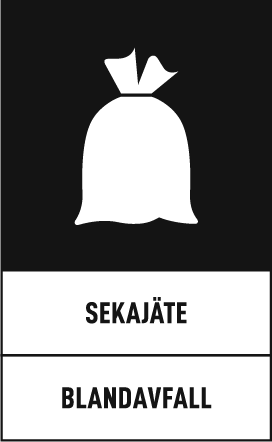
❗ IN OY BOTNIAROSK AB’S OPERATING AREA, THE TERM “COMBUSTIBLE WASTE” IS BEING CHANGED TO “MIXED WASTE” ❗
“Mixed waste” is the commonly used term in Finland for waste that cannot be recycled. We are aligning our terminology with the rest of the country to make communication and sorting instructions clearer and more consistent.
Sorting practices will remain exactly the same as before. The same waste that was previously placed in combustible waste should continue to be placed in mixed waste. Only the name changes – the contents stay the same!
Household waste that does not belong in your own waste bin or at an eco-point should primarily be taken to a recycling station. As a rule of thumb, waste equivalent to a car trailer should be taken to a recycling station, while a tractor trailer containing a single type of waste should be taken to the waste management centre.
.png)
In cooperation with producer organizations, Botniarosk offers free reception of greenhouse lamps at its waste management centre in Teuva.
The lamps are placed in 200-litre barrels. Empty barrels can be collected from the centre and returned when full. Alternatively, lamps can be delivered directly to the centre and placed in the barrels there.
If you plan to dispose of more than 3,000 lamps at once, you should contact the waste management centre in advance to ensure that enough empty barrels are available. Contact: +358 44 380 8991.
Asbestos waste must be packaged and handled in such a way that asbestos dust does not spread into the environment during transport or handling.
Asbestos waste is hazardous and must be handled with special care.
It must be packaged so that the packaging does not break at any stage of handling. Waste of all sizes must be tightly packed, for example in fiberglass sacks or sacks of equivalent strength, in construction plastic, or in tarpaulins. The packaging material must be at least 0.12 mm thick and must be tightly sealed with tape or ties.
Ordinary garbage bags are not suitable for asbestos, as they tear easily.
All packages and loads containing asbestos must be clearly labeled with the text:
“Asbestijätettä. Pölynhengittäminen vaarallista. / Asbestavfall. Farligt att inandas. / Asbestos waste. Hazardous to inhale.”
Asbestos must not be mixed with other waste. At the waste management centre, the load is inspected, and if there is reason to suspect asbestos, the entire batch is classified as asbestos waste. Any waste suspected of containing asbestos is treated as asbestos for safety reasons. Examples include minerit boards, toja/tojax boards, and fiber cement sheets.
Packaging and protective materials used with asbestos—such as tarpaulins, protective plastics, containment structures used during demolition, protective clothing, filters, and similar materials that have been or may have been in contact with asbestos or asbestos dust—are also classified as asbestos waste.
If there is reason to suspect that waste may contain asbestos but it does not (for example, if the product was manufactured after 1994), reliable documentation such as an asbestos analysis or survey report must be provided before unloading.
The waste holder/supplier is responsible for providing this documentation before delivering the load.
Typical asbestos waste includes materials and protective structures from demolition work, old pipe insulation, flooring materials and adhesives, vinyl tiles (pre-1994), roofing felt, and various roofing and wall panels. Asbestos was widely used in construction materials especially between 1920 and 1990, so it may be present in many structures in older buildings.
For occupational and environmental safety reasons, asbestos is removed from circulation and disposed of in a designated section of the landfill.
Workers performing asbestos removal must have a valid permit. Personnel must be registered as qualified asbestos removal workers, and the work must be reported in advance to occupational safety authorities.
Website of the Occupational Safety and Health Administration in Finland: Asbestos removal licences
Waste management centre price list
Horontie 526, Östermark (Teuva)
+358 6 721 0156
Waste treatment and the functions related to directing waste to further processing are centralized at the waste management centre. Combustible waste is delivered to the centre’s transfer station, and recyclable materials from customers, recycling stations, and eco-points are stored in designated areas. Garden waste is composted in a specific composting area, and, for example, concrete waste is crushed in a designated storage area. Landfill waste is disposed of at the centre’s landfill site. Large quantities of waste are accepted at the facility.
